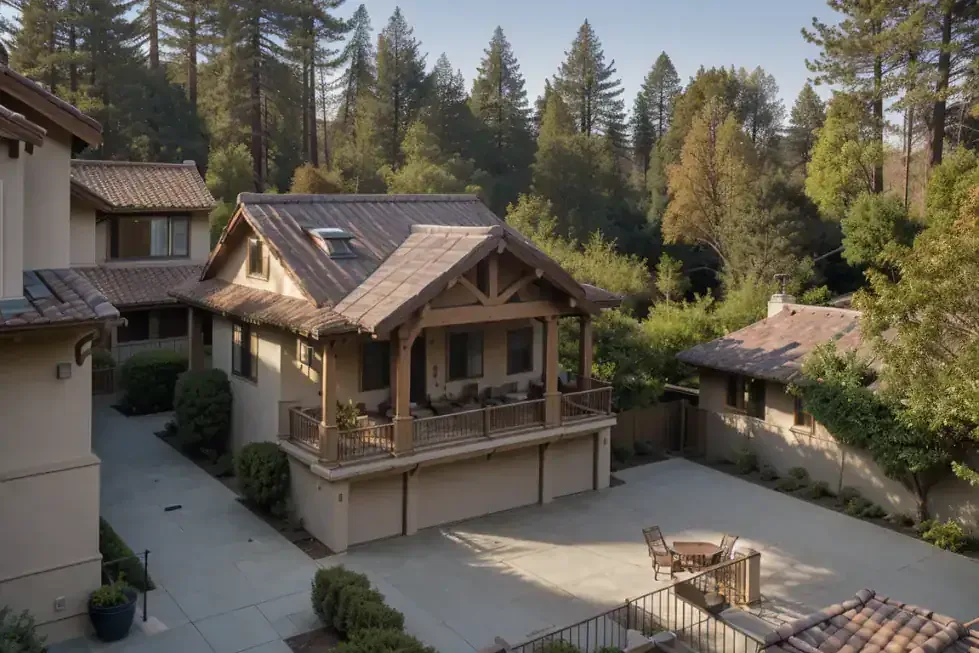
Roofing in Alameda, CA
Salt air and marine fog define roofing here before anything else.
Alameda sits on an island in San Francisco Bay, and every exposed roofline takes the hit.
Call (415) 753-4712Serving Alameda and
Fog cuts sun exposure for much of the year, so shingle surfaces stay damp longer than inland roofs.
Then winter storms arrive concentrated, driving rain sideways against west-facing slopes. Housing stock tells the rest of the story.
West End and Central Alameda hold Victorian and Edwardian homes from the early 1900s, many with complex hips, gables, and dormers.
Bay Farm Island and South Shore lean mid-century, with lower pitches and wide eaves.
Versailles and Encinal mix Craftsman bungalows from the 1920s and 1930s with later additions. Typical failure modes follow from that combination:
- Corroded fasteners and flashing on bay-exposed slopes
- Moss and algae growth where fog keeps felt and shingles wet
- Wind-lifted ridge caps and rake edges during storm fronts
- Failed pipe boots and chimney flashing on older homes
- Ponding near low-slope additions and parapet walls
Original wood shake and cedar shake roofs on older Victorians reach end of life faster in this salt-laden air.
So do the tar paper underlayments beneath them. A roofer inspecting an Alameda roof should check attic-side staining as carefully as the rooftop surface.
What Roofing Work in Alameda Includes
Scope starts with a roof inspection, not a sales visit.
That means walking the planes, checking the attic for daylight and water staining, and probing the sheathing and rafters where accessible.
A written roof estimate should itemize decking repair separately from covering replacement.
Tear-off and prep follow. Crews strip the old covering, remove failed underlayment, and inspect the roof deck for soft plywood or osb.
Any rotted sheathing gets replaced before new material goes down.
A dumpster staged on the street handles debris, and scaffold or ladder setup depends on pitch and height.
Materials for Alameda roofs typically include:
- Asphalt shingles: three-tab shingle for budget work, architectural shingle for wind ratings
- Standing-seam panel or corrugated panel metal, popular on bay-exposed slopes
- Concrete tile or clay tile on Mediterranean-style homes
- Tpo, epdm, or pvc membrane on low-slope and flat sections
- Modified bitumen or built-up roof systems where pitch is minimal
Installation sequence matters more than brand names. Ice-and-water shield goes at eaves and valleys. Synthetic underlayment covers the field.
Drip edge protects the fascia and eave line, while ridge vent and soffit vent keep attic ventilation working.
Step flashing and counter-flashing seal wall intersections, and chimney flashing gets rebuilt, not caulked over.
Fastening is where shortcuts hide. Nail gun pressure and placement follow the shingle manufacturer's nailing pattern.
On metal, screw type and gasketed washers decide whether the roof leaks in year three. Sealant and caulk are touch-up tools, never the primary waterproofing.
Cleanup closes the job: magnet sweep for nails, gutter and downspout clearing, and a final walk-through of the roofline from the ground.
Questions about your roof?
Call (415) 753-4712Quality & Materials Standards
Code compliance in Alameda starts with the building code edition adopted locally and the manufacturer's installation instructions. Those instructions govern fastener spacing, underlayment, and valley treatment.
A roofing contractor who cannot name the warranty terms in writing is a risk.
Honest claims about materials:
- Architectural shingle warranties are prorated and rarely pay full replacement
- Metal panel lifespan depends on coating quality, not just gauge
- Tile and slate need structural verification before installation
- Membrane roofs fail at seams and penetrations first
Some details are coastal-specific. A parapet wall needs proper coping and counter-flashing to shed wind-driven rain. Scuppers and downspouts must size to storm volume.
Apron flashing at the base of a chimney and boot flashing at each vent boot are common leak points on older roofs.
Steep-slope assemblies also involve purlin and batten or counterbatten framing, especially under tile or slate. Those layers create the ventilation gap that keeps the substrate dry.
Verge edges, hip and ridge terminations, and every skylight curb deserve close inspection.
Snow guards and ice dam protection seem out of place in Alameda.
They still apply on shaded north slopes where fog condensation freezes at the eave during cold snaps. So do ice-and-water shield membranes at valleys.
For flat or commercial-adjacent sections, coating and adhesive systems extend life but do not fix failed waterproofing. Roof cement and mastic are stopgaps.
Real weatherproofing means correct flashing geometry and drainage.
Homeowners should ask for:
- Written manufacturer specifications matched to the actual roof assembly
- Clarification of who files any insurance claim and what the roofing contractor documents
- A punch list covering vent boot, apron flashing, and downspout tie-ins
Small accessories matter too. A canopy or awning over an entry needs its own flashing detail, not caulk at the roofline.
An attic fan or rooftop vent must be re-flashed, not reused.
When comparing bids, read the scope line by line.
A quote that lists shingle and underlayment but omits drip edge, ridge cap, or fasteners is not complete.
The roofing square count should match the measured roof area, including waste for hips and valleys.
Finally, verify licensing and insurance before work starts. Alameda homeowners can request proof of coverage in writing.
A deposit schedule tied to milestones protects the homeowner more than a verbal promise.
Seasonal and Storm Exposure in Alameda
Alameda's marine layer is the defining pressure on local roofs.
Fog rolls in off San Francisco Bay and cuts direct sun exposure across the West End and South Shore for much of the year.
Less UV sounds gentle, but it changes how roofs age.
Constant damp from fog accelerates the breakdown of asphalt and bitumen. Shingle granules loosen slowly, and organic growth creeps into shaded valleys and north-facing planes.
A rooftop that looks intact from the curb can hide soft felt and failing tar paper beneath.
Rainfall is modest, but it arrives compressed into winter storm season.
Sheets of wind-driven rain hit exposed rooflines hard, especially on Bay Farm Island and Alameda Point.
That is when old flashing, cracked sealant, and worn pipe boots finally leak.
Salt air corrosion from the bay is the quiet third force.
It eats at fasteners, metal drip edge, valley flashing, and gutter hangers faster than inland exposure would.
Galvanized steel and cheap screws pit and rust years early.
The inspection calendar follows directly from these three forces:
- Late summer: check ridge caps, pipe boots, and chimney flashing before the first storm.
- Mid-winter: look for ice dam risk on low-slope sections and clogged downspouts.
- Early spring: assess fog-driven moss, granule loss, and painted fascia rot.
- After any big blow: inspect exposed eaves and rake edges for lifted shingle tabs.
Questions about your roof?
Call (415) 753-4712Local Service Areas
West End
The West End holds some of Alameda's oldest housing stock, including Victorian and Edwardian homes from the early 1900s.
Steep pitch roofs here often carry original wood shake or cedar shake beneath newer layers, and mismatched repairs are common.
- Cedar shake that has dried and split after a century of fog cycles
- Steep pitch and mansard-style planes where ladder access is difficult
- Original wood fascia and soffit showing rot at the eave line
- Old tar and bitumen patches over failing roofing felt
- Rotted sheathing and plywood revealed when a roofer strips old layers
Bay Farm Island
Bay Farm Island's mid-century modern construction from the 1950s through 1970s favors low-slope roofs.
Those low pitches demand membrane systems rather than shingle, and many have aged past their service life.
- Original built-up roof layers holding trapped moisture
- Modified bitumen patches that have cracked at the seams
- Flat sections where ponding water stresses the membrane and scupper drains
- Rusted metal flashing and counter-flashing at parapet walls
- Aging pipe boot and vent boot seals on rooftop penetrations
- Poor attic ventilation causing condensation under the decking
Versailles
Versailles blends Craftsman bungalows from the 1920s and 1930s with later infill.
Gable and hip rooflines with generous overhangs are the norm, and the wide eaves collect debris and harbor rot.
- Craftsman gable and hip roofs with exposed rafter tails
- Three-tab shingle and architectural shingle reaching end of life
- Debris-packed gutters and downspouts under deep overhangs
- Weathered fascia and soffit vent boards at the verge
- Deteriorated step flashing where dormers meet the main roof
Encinal
Encinal's mix of older Victorians and mid-century homes produces varied roof challenges. Dormers, skylights, and add-on sections create valleys and transitions that concentrate leaks.
- Skylight and dormer penetrations with aging sealant and caulk
- Valley flashing that has rusted through from salt air
- Mixed roofing materials from decades of partial reroofs
- Loose nails and fasteners backing out of older decking
- Ridge vent and soffit vent systems that no longer balance airflow
South Shore
South Shore's mid-century modern homes sit close to Crown Memorial State Beach, where bay wind and salt hit exposed rooflines directly.
Low-slope and shallow-pitch roofs dominate here.
- Wind-lifted shingle tabs and ridge cap loss on exposed planes
- Corroded metal panel and corrugated panel sections
- Salt-driven rust on drip edge and gutter hardware
- Flat or low-slope sections needing TPO, EPDM, or PVC membrane evaluation
- Failing sealant at parapet coping and apron flashing
Central Alameda
Central Alameda mixes Victorian commercial-era buildings with Craftsman homes near the Alameda Theatre. Historic rooflines often carry decorative parapets and complex detailing that need careful repair.
- Decorative parapet and cornice details hiding water intrusion
- Slate and clay tile sections mixed with later asphalt shingle
- Chimney flashing and counter-flashing failures on older masonry
- Aging underlayment beneath visible-but-failing shingle
- Original sheathing and board decking that needs careful assessment
Get Your Alameda Roof Assessed
Alameda roofs face fog, salt air, and compressed winter storms — a combination that hides damage until it leaks.
Whether your home sits in the West End or near Crown Memorial State Beach, a professional roof inspection clarifies what your rooftop actually needs.
Before hiring any roofing contractor, verify licensing, insurance, and a written roof estimate that itemizes materials and labor.
Ask how they handle debris removal, scaffolding, and code compliance for your roof type.
Call (415) 753-4712 or reach out through the contact form to start the conversation.
Questions about your roof?
Call (415) 753-4712Services in Alameda
Roof Repair
Professional roof repair services in Alameda.
Roof Inspection
Professional roof inspection services in Alameda.
Roof Replacement
Professional roof replacement services in Alameda.
Gutter Installation
Professional gutter installation services in Alameda.
Metal Roofing
Professional metal roofing services in Alameda.
Roof Leak Detection
Professional roof leak detection services in Alameda.
Storm Damage Repair
Professional storm damage repair services in Alameda.
Commercial Roofing
Professional commercial roofing services in Alameda.
Insurance Claim Assistance
Professional insurance claim assistance services in Alameda.
Tile Roofing
Professional tile roofing services in Alameda.
Fascia Soffit Repair
Professional fascia soffit repair services in Alameda.
Roof Ventilation
Professional roof ventilation services in Alameda.
Shingle Roofing
Professional shingle roofing services in Alameda.
Emergency Roof Repair
Professional emergency roof repair services in Alameda.
Skylight Installation
Professional skylight installation services in Alameda.
Roof Coating
Professional roof coating services in Alameda.
Compare Written Estimates in Alameda
Independent Local Providers and provider-held · serving California
Call (415) 753-4712