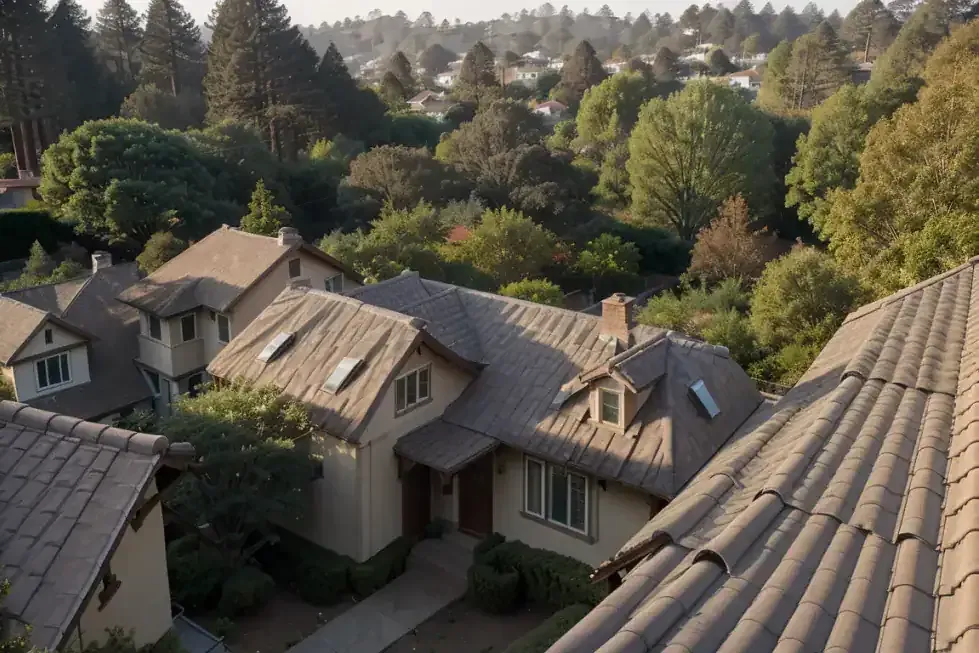
Roofing in Berkeley, CA
Berkeley roofs work hard in two opposite directions. Winter storms push rain sideways, and summer brings ember risk to the hills.
Call (415) 753-4712Serving Berkeley and
Both shape how a rooftop here gets built and repaired. Housing stock varies sharply by neighborhood. West Berkeley holds surviving Victorian buildings with steep, complex rooflines.
Northside carries Arts and Crafts and First Bay Tradition homes.
Brown shingle houses rose across the city between 1895 and 1915, and that brown shingle is siding — not proof the roof is wood shingled today.
- West Berkeley: Victorian-era steep roofs, tight lots, limited staging
- Northside: Arts and Crafts detail, dormers, multiple valleys
- Elmwood and Northbrae: period homes with mixed original and replacement coverings
- San Pablo Park: flatter lots, varied eras, more composition asphalt shingle
Weather drives failures in predictable ways. City storm guidance names heavy rainfall, strong gusts, clogged drain hazards and falling trees.
Wind tears at ridge cap and drip edge. Clogged gutters back water under eave edges. A downspout that dumps at the foundation is its own problem.
Ember intrusion matters in mapped fire hazard and WUI areas. Berkeley's Class A roof assembly rules apply there, and BMC 19. 49.
060 prohibits wood shake and shingle coverings in those zones. Parcel applicability must be checked — the city is not uniformly WUI.
Typical failure modes for this climate:
- Wind-lifted shingle tabs and failed sealant at the rake
- Water backing up at valleys and step flashing when debris blocks flow
- Rot at fascia and soffit from chronic gutter overflow
- Cracked membrane seams on flat sections after thermal cycling
- Ember entry at vents and gaps in covered fire zones
Roofing permits come from the City of Berkeley Planning and Development Department, Building and Safety Division. Alterations and most repairs need one.
A full reroof goes through the Permit Service Center. The small-repair exemption threshold is unknown, so ask. Berkeley sits in climate zone 3.
The 2025 single-family reroof provisions impose no prescriptive cool-roof reflectance requirement. That removes one compliance headache — not the permit itself.
What Roofing Work in Berkeley Includes
A roof inspection starts with a walk of the perimeter and a look at the attic from below.
The roofer checks the roof deck and sheathing for soft spots, then traces stains back to a source.
Binoculars handle the steep West Berkeley pitches that a ladder cannot safely reach.
Scope on a repair usually covers:
- Flashing: step flashing, counter-flashing, chimney flashing, pipe flashing and boot flashing
- Sealant and mastic at penetrations, plus roof cement where a patch is honest
- Ridge cap, drip edge and rake trim replacement
- Debris removal from valleys and gutters, then a downspout flow test
A full replacement moves in stages. Tear-off comes first, with a dumpster staged and debris hauled out.
Old roofing felt and tar paper come up with the covering. The crew inspects sheathing, replacing plywood or OSB where it has delaminated.
Deck repair precedes any new layer. Rafters and joists get checked for rot, and a ridge beam or purlin gets flagged if it has sagged.
Synthetic underlayment goes down over the deck, with ice-and-water shield at valleys and low-slope transitions. New fasteners — nails or screws — follow the manufacturer's pattern.
Covering choice follows the structure and the zone. Composition asphalt shingle, including architectural shingle and three-tab shingle, suits most pitched roofs.
Tile, clay tile or concrete tile needs a deck rated for the weight.
Metal panel, standing-seam panel and corrugated panel work on both pitch and low-slope runs.
Flat sections use membrane systems: TPO, EPDM or PVC membrane, or a built-up roof with modified bitumen.
Each has its own seaming method and its own repair vocabulary.
Ventilation and trim finish the job. Ridge vent pairs with soffit vent. Fascia and soffit get repaired or replaced before the gutter and downspout go back.
A skylight or dormer gets fresh flashing and a checked seal.
Cleanup is part of scope. Magnets sweep for nails, and the site gets walked before the dumpster leaves.
A punch list confirms what was and was not included.
Questions about your roof?
Call (415) 753-4712Quality & Materials Standards
Material choice should follow the roof, not the reverse.
A steep Victorian roofline in West Berkeley may need hand detailing at valleys and dormers that a production crew rushes.
A flat section needs a membrane system designed for ponding and sun.
Standards worth verifying before work starts:
- Class A assembly where the parcel sits in a covered fire hazard or WUI area
- Manufacturer installation specs for the specific shingle, tile or metal panel
- Correct underlayment grade — synthetic underlayment over felt where specified
- New flashing rather than reused step flashing and counter-flashing
- Written scope separating repair from replacement
Building code compliance runs through the permit. A roofing contractor should pull it, and the inspection record should match what was installed.
Ask which code edition and which local amendment the plan follows.
Honest claims vocabulary matters. Storm damage is described by cause and location, not by dollar figure.
Documentation means dated photos, a written roof inspection report and an itemized roof estimate. Insurance adjusters respond to specifics: which slope, which flashing, how much decking.
Quality shows in details that are easy to skip:
- Fastener pattern and depth, checked against the shingle or panel spec
- Ice-and-water shield at valleys and eave edges
- Counter-flashing cut into masonry rather than surface-caulked
- Ridge cap and hip detail aligned to the roofline
- Ventilation balance between intake and exhaust
Materials age differently here. Asphalt shingle and architectural shingle shed granules over time. Clay tile and slate can outlast the fasteners holding them.
Metal panel and standing-seam panel resist wind uplift well when clipped correctly. Membrane seams on TPO and EPDM are the weak point on flat work.
A roofer should explain why a repair is or is not viable. Patching a valley that keeps failing is not waterproofing. It is delay.
Get the reasoning in writing, along with what the substrate looked like once opened.
Seasonal and Storm Exposure in Berkeley
Berkeley's roof year splits cleanly in two. From roughly October through April, storms roll in off the Pacific with sustained rain and strong gusts.
The city's own storm guidance flags clogged drains and falling trees as recurring hazards. That combination punishes every material on this housing stock.
Winter rain finds the weak points first. On asphalt shingle roofs, water works under lifted tabs and into aged roofing felt.
Brown shingle and Victorian buildings in West Berkeley often hide soft roof deck boards beneath.
Flat TPO and modified bitumen systems depend on intact membrane seams and clear scuppers.
Wind matters as much as water. Gusts drive rain sideways into step flashing, chimney flashing and pipe boots.
A loose ridge cap or drip edge becomes an entry point fast. Fallen limbs and trees open punctures that stay hidden until a ceiling stain appears.
Wildfire exposure adds a summer dimension.
In mapped fire hazard and WUI parcels, BMC 19.49.060 requires Class A roof assemblies and bans wood shake and cedar shake coverings.
Ember intrusion through eave gaps and vents is the threat there.
Inspection timing follows the calendar:
- Late fall: clear gutters and downspouts, check sealant at flashing and valleys before the first big storm.
- After any wind event over roughly 40 mph: look for displaced shingles, ridge cap damage and debris on the rooftop.
- Late winter: interior checks for attic staining, damp sheathing and daylight at the roof deck.
- Spring: full roof inspection of underlayment condition, fasteners and eave lines before dry season.
Climate zone 3 means the 2025 single-family reroof rules impose no prescriptive cool-roof reflectance requirement. Verify that against your own permit scope rather than assuming.
Questions about your roof?
Call (415) 753-4712Local Service Areas
West Berkeley
West Berkeley holds some of the city's oldest surviving Victorian buildings, many now past a century of roof cycles.
Roofs here tend to be patchworks of repairs over original framing, which makes honest assessment the first step.
- Victorian-era roof decks often carry multiple layers of old tar paper and roofing felt that trap moisture.
- Original rafter and joist ends near the eave can show rot where gutter overflow has gone unchecked.
- Mansard and steep gable rooflines on older homes complicate access and often need scaffold rather than a ladder.
- Chimney flashing and step flashing on shared walls are frequent leak sources between attached structures.
- Flat-roof rear additions commonly rely on aging modified bitumen or a built-up roof nearing replacement.
Northside
Northside's Arts and Crafts and First Bay Tradition houses sit close to the hills, where wind exposure runs higher.
Brown shingle siding defines the look, but the roof covering above is usually asphalt shingle today.
- Steep gable and hip roofs shed rain well until ridge vent and soffit vent balance fails, trapping attic moisture.
- Deep eave overhangs protect walls but hide fascia rot and loose drip edge until damage spreads.
- Tree canopy overhead drops debris that clogs valleys and speeds shingle granule loss.
- Skylights and dormers interrupt the plane, so pipe flashing and counter-flashing there need close inspection.
- Older plywood or OSB sheathing may delaminate under repeated wetting before shingles show wear.
Elmwood
Elmwood's mix of period homes and later infill means roof ages vary block to block.
Composition asphalt shingles dominate, with tile and flat membrane roofs on additions and remodels.
- Three-tab shingle roofs from earlier decades show curling, granule loss and exposed nail heads.
- Concrete tile and clay tile roofs hold up but depend on intact underlayment beneath, which fails first.
- Valley areas collect leaf litter and are where leaks most often begin on complex rooflines.
- Detached garages and awnings often have the oldest, least maintained roofing on the property.
- A roof estimate here should separate covering condition from substrate and flashing condition.
San Pablo Park
San Pablo Park's housing runs toward early-to-mid twentieth century bungalows and small apartment buildings.
Roofs are typically modest in pitch, which changes what fails and how repairs are done.
- Low-slope sections frequently use roll roofing or modified bitumen with seam failures at the edges.
- Gutter and downspout connections at tight lot lines overflow and soak fascia boards.
- Small dormers and porch canopies create short rake and eave runs where flashing gets skipped.
- Older tar and asphalt patching accumulates, hiding the true decking condition underneath.
- Fastener and fastener-backed sealant failures show up as blistering after hot summers.
Northbrae
Northbrae's early twentieth century houses often combine steep roofs with decorative detail.
The result is more roofline, more transitions, and more places for water to find a way in.
- Complex hip-and-gable intersections multiply valley and flashing details that need careful waterproofing.
- Decorative overhangs and exposed rafter tails weather faster than the main roof covering.
- Standing-seam panel and metal panel accents on some homes need fastener and sealant checks at penetrations.
- Gutter systems on steep pitches carry high water volume, stressing hangers and fascia attachment.
- Attic ventilation through gable and soffit vents should be verified whenever the roofing is replaced.
Get a Berkeley Roof Assessment
Berkeley roofs reward timing. Clear the gutters before the rains, inspect after the winds, and check the flashing before summer.
If a roof inspection turns up soft sheathing, failed underlayment or a covering past its service life, get a written roof estimate that names the materials and the permit path through the Building and Safety Division.
Call (415) 753-4712 or use the contact form to start.
Questions about your roof?
Call (415) 753-4712Services in Berkeley
Roof Repair
Professional roof repair services in Berkeley.
Roof Inspection
Professional roof inspection services in Berkeley.
Roof Replacement
Professional roof replacement services in Berkeley.
Gutter Installation
Professional gutter installation services in Berkeley.
Metal Roofing
Professional metal roofing services in Berkeley.
Roof Leak Detection
Professional roof leak detection services in Berkeley.
Storm Damage Repair
Professional storm damage repair services in Berkeley.
Commercial Roofing
Professional commercial roofing services in Berkeley.
Insurance Claim Assistance
Professional insurance claim assistance services in Berkeley.
Tile Roofing
Professional tile roofing services in Berkeley.
Fascia Soffit Repair
Professional fascia soffit repair services in Berkeley.
Roof Ventilation
Professional roof ventilation services in Berkeley.
Shingle Roofing
Professional shingle roofing services in Berkeley.
Emergency Roof Repair
Professional emergency roof repair services in Berkeley.
Skylight Installation
Professional skylight installation services in Berkeley.
Roof Coating
Professional roof coating services in Berkeley.
Compare Written Estimates in Berkeley
Independent Local Providers and provider-held · serving California
Call (415) 753-4712