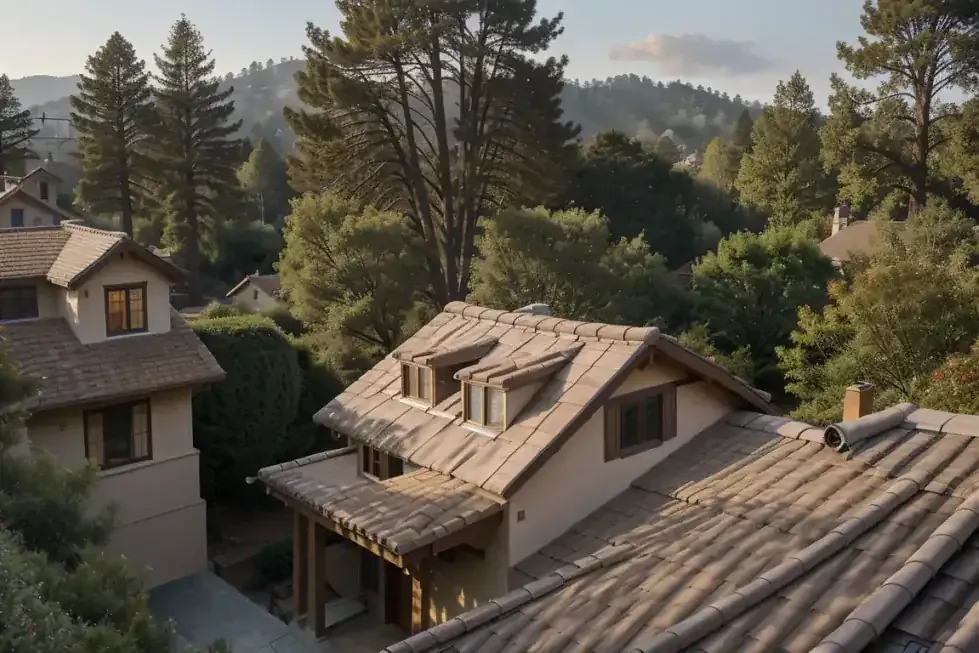
Roofing in Lafayette, CA
Lafayette sits at roughly 320 feet in Contra Costa County, and its roofs live with two opposing stresses.
Call (415) 753-4712Serving Lafayette and
Then heavy winter rainstorms arrive fast. That swing drives most of the failures worth knowing. Asphalt shingle granules loosen under summer heat, exposing the bitumen beneath.
Wood shake dries, splits, and cups before the first storm tests it. Housing stock here is unusually varied for one ZIP code.
Mid-century ranch homes from the 1950s and 1960s dominate the flat lots.
Custom hillside estates with bay views climb the ridges, and Craftsman-style bungalows from the early 1900s remain near the older village core. Each type fails differently.
Ranch homes often have shallow pitch and wide eave overhangs where fascia and soffit weather first.
Hillside estates expose rake edges and ridge lines to wind that low lots never see. - Low areas near Happy Valley and the St.
Mary's Road Corridor hold morning fog and dew, which feed moss and rot at the eave.
- Exposed ridgelines in Lafayette Hills and Acalanes Ridge take wind-driven rain against rake and gable ends.
- Tree-heavy lots in Reliez Valley and Burton Valley collect oak litter that traps moisture in valleys and gutters.
The Lafayette Reservoir and the Lafayette Moraga Regional Trail sit in the fog belt, and roofs nearby stay damp longer each morning.
Oak tree preservation is part of the city's history, so mature canopy overhangs many roofs. That shade is welcome in August.
It also means roof inspection should include debris loading, valley clearance, and the condition of pipe flashing and step flashing around penetrations.
The 94549 ZIP includes homes near Acalanes High School and along the St. Mary's Road Corridor, where roof age varies block to block.
A roofer reading a roof here must judge era and assembly together, not just shingle color.
What Roofing Work in Lafayette Includes
A roof estimate in Lafayette should start with a real roof inspection, not a driveway glance.
That means walking the roof deck where pitch allows, or using a ladder and scaffold at the eave where it does not.
Inspection scope covers the whole assembly, not just the surface:
- Field shingles or panels, checking for granule loss, cracking, and lifted nails.
- Flashing at the chimney, skylight, dormer, and every pipe boot or vent boot.
- Valleys, ridge cap, drip edge, fascia, and the gutter and downspout runs.
- Attic side: sheathing, rafters, truss condition, insulation, and ventilation.
Tear-off follows. Crews remove the old roof covering down to the roof deck, then inspect plywood or OSB sheathing for soft spots.
A pry bar or roofing shovel handles shingle removal; a dumpster holds the debris.
Decking repair comes next, replacing rotted sheathing and any damaged rafter tails.
Synthetic underlayment goes down over the deck, with ice-and-water shield at valleys and eaves where code or exposure warrants.
Materials depend on the home. Architectural shingle suits many mid-century ranches; three-tab shingle is lighter and cheaper but shorter-lived.
Wood shake and cedar shake fit Craftsman bungalows, while slate, clay tile, and concrete tile appear on custom estates.
Metal panel systems, including standing-seam panel and corrugated panel, work well on hillside homes with complex rooflines.
Low-slope sections may call for membrane assemblies such as TPO, EPDM, or PVC membrane, or a built-up roof with modified bitumen.
Installation details matter as much as material. Ridge vent and soffit vent must balance for proper ventilation.
Sealant, caulk, and mastic belong at terminations, never as a substitute for correct flashing.
Cleanup is part of the scope. Magnetic sweeps for nails and fasteners, gutter clearing, and debris haul-off should be written into the estimate.
A roofing square, nail gun, and air compressor are standard trade tools; their use should be reflected in a clear, itemized bid.
Questions about your roof?
Call (415) 753-4712Quality & Materials Standards
Quality on a Lafayette roof starts with the substrate. Sheathing that flexes underfoot will crack tile and loosen fasteners, no matter the covering above.
Any roofer should confirm decking condition before quoting a re-roof.
Underlayment choice separates good assemblies from marginal ones.
Roofing felt and tar paper still appear, but synthetic underlayment resists tearing and handles the summer heat cycle better.
Ice-and-water shield belongs at valleys, eaves, and around penetrations.
Flashing is where most leaks begin. Step flashing, counter-flashing, chimney flashing, and apron flashing must be replaced, not reused, when the roof covering changes.
Boot flashing and pipe flashing around vents fail quietly and show up as ceiling stains months later.
Building code in this region governs fastening schedules, ventilation ratios, and fire-rated assemblies.
Homes near wildfire exposure should ask about Class A rated coverings and ember-resistant detailing at the eave and ridge.
- Fire-rated assembly and ember-resistant vents for wildfire exposure.
- Balanced intake at soffit vent with exhaust at ridge vent.
- Correct nailing pattern, with nail heads set flush and not overdriven.
- New drip edge, valley metal, and sealant at all terminations.
Watch for shortcuts. Reused flashing, caulk over failed mastic, and a new layer of shingle over old felt without deck inspection all hide problems.
A proper roof inspection and a written roof estimate should list every layer being removed and replaced.
Ventilation deserves its own line item. Attic fan placement, insulation depth, and a vapor barrier in the right assembly reduce condensation that rots sheathing from below.
On hillside homes, wind-driven rain at the rake and gable ends calls for careful weatherproofing and waterproofing details, not just surface coating.
Seasonal and Storm Exposure in Lafayette
Lafayette summers bake rooftops. Months of hot, dry air pull moisture from asphalt shingle and cedar shake, leaving them brittle by September.
One fallen oak branch can crack a weathered field of three-tab shingle.
Wildfire risk sits over every roofline here. Ember-tight details matter more than curb appeal.
A missing ridge cap or gap at the drip edge gives embers a way in.
Winter flips the script. Heavy rain arrives fast, and a tired underlayment shows it. Water finds failed chimney flashing and pipe boots first.
Fog and morning dew settle in low pockets like Reliez Valley. Constant damp works on old felt and tar paper. Moss and rot follow.
Watch for these after a wet season:
- Stained ceiling near a valley or skylight.
- Lifted or curling shingle tabs on south slopes.
- Granules collecting in gutters and downspouts.
- Rusted fasteners and soft plywood or OSB sheathing.
- Cracked sealant at step flashing and counter-flashing.
Timing follows the weather. Book a roof inspection in spring, after the rain stops and before the dry heat sets in.
Early fall is the second window, ahead of the first storms.
Both passes make sense for a 1950s ranch or a hillside estate with bay views.
A roofer can map the pitch, valley and eave details while the material still tells the story. That roof estimate is cheaper than a rebuild.
Questions about your roof?
Call (415) 753-4712Local Service Areas
Happy Valley
Happy Valley holds a mix of mid-century ranch homes and custom builds tucked against the hills.
Dry summers age exposed rooftops quickly, so material condition drives most repair calls.
- 1950s–60s ranch roofs with three-tab shingle that curls and sheds granules.
- Aging tar paper and felt underlayment that tears during heavy winter rain.
- Gable-end fascia and soffit showing dry rot after foggy mornings.
- Original vent boots dried out and cracked at pipe penetrations.
- Flat or low-slope sections where a membrane or modified bitumen patch is due.
Burton Valley
Burton Valley's flat lots suit ranch homes from the 1950s and 1960s with wide, low rooflines.
Those shallow pitches put pressure on every valley and flashing joint.
- Low-slope sections where built-up roof or modified bitumen wears thin.
- Step flashing at wall intersections that lifts and lets water in.
- Ridge vent and soffit vent systems clogged with leaves and debris.
- Gutter and downspout runs that back up during winter storms.
- Asphalt shingle fields cracked along hip and ridge lines.
Lafayette Hills
Lafayette Hills is custom hillside estate country, with steep pitches and bay views.
Steep roofs shed water well but punish the wrong material and the wrong installer.
- Steep slopes better suited to standing-seam panel than to thin shingle.
- Cedar shake and slate where wind-driven rain tests every lap.
- Scaffold and ladder access needed for safe roof inspection on tall pitches.
- Dormer and skylight flashing that fails first at the rake.
- Eave overhangs where moisture collects behind the fascia board.
Reliez Valley
Reliez Valley sits lower and holds fog and morning dew longer than the ridges. That steady damp is hard on wood and old fasteners.
- Cedar shake and wood shake that stays wet and grows moss.
- Roof deck and rafter ends softening under trapped moisture.
- Rusted nails and fasteners backing out of aging sheathing.
- Drip edge and gutter seams leaking into the eave.
- Vapor barrier and insulation issues showing up as attic condensation.
Acalanes Ridge
Acalanes Ridge mixes mid-century homes with newer custom builds near the open hills. Wildfire exposure shapes how a rooftop here should be detailed.
- Ember-resistant detailing at ridge cap, verge and eave gaps.
- Class-rated shingle or metal panel replacing aging three-tab.
- Chimney flashing and counter-flashing checked for gaps.
- Dry, wind-scoured slopes where sealant and mastic crack.
- Decking and OSB inspected for heat damage under dark shingles.
Get a Lafayette Roof Inspection
Lafayette roofs face dry heat, wildfire embers and hard winter storms in one year.
Match the material to the pitch, the neighborhood and the exposure before anything gets nailed down.
Ask any roofing contractor for a written roof estimate, proof of insurance and the building code details they follow.
Confirm how they handle debris, dumpster placement and cleanup. Then compare two or three bids on scope, not just price.
Call (415) 753-4712 or send details through the contact form to start a roof inspection.
Questions about your roof?
Call (415) 753-4712Services in Lafayette
Roof Repair
Professional roof repair services in Lafayette.
Roof Inspection
Professional roof inspection services in Lafayette.
Roof Replacement
Professional roof replacement services in Lafayette.
Gutter Installation
Professional gutter installation services in Lafayette.
Metal Roofing
Professional metal roofing services in Lafayette.
Roof Leak Detection
Professional roof leak detection services in Lafayette.
Storm Damage Repair
Professional storm damage repair services in Lafayette.
Commercial Roofing
Professional commercial roofing services in Lafayette.
Insurance Claim Assistance
Professional insurance claim assistance services in Lafayette.
Tile Roofing
Professional tile roofing services in Lafayette.
Fascia Soffit Repair
Professional fascia soffit repair services in Lafayette.
Roof Ventilation
Professional roof ventilation services in Lafayette.
Shingle Roofing
Professional shingle roofing services in Lafayette.
Emergency Roof Repair
Professional emergency roof repair services in Lafayette.
Skylight Installation
Professional skylight installation services in Lafayette.
Roof Coating
Professional roof coating services in Lafayette.
Compare Written Estimates in Lafayette
Independent Local Providers and provider-held · serving California
Call (415) 753-4712