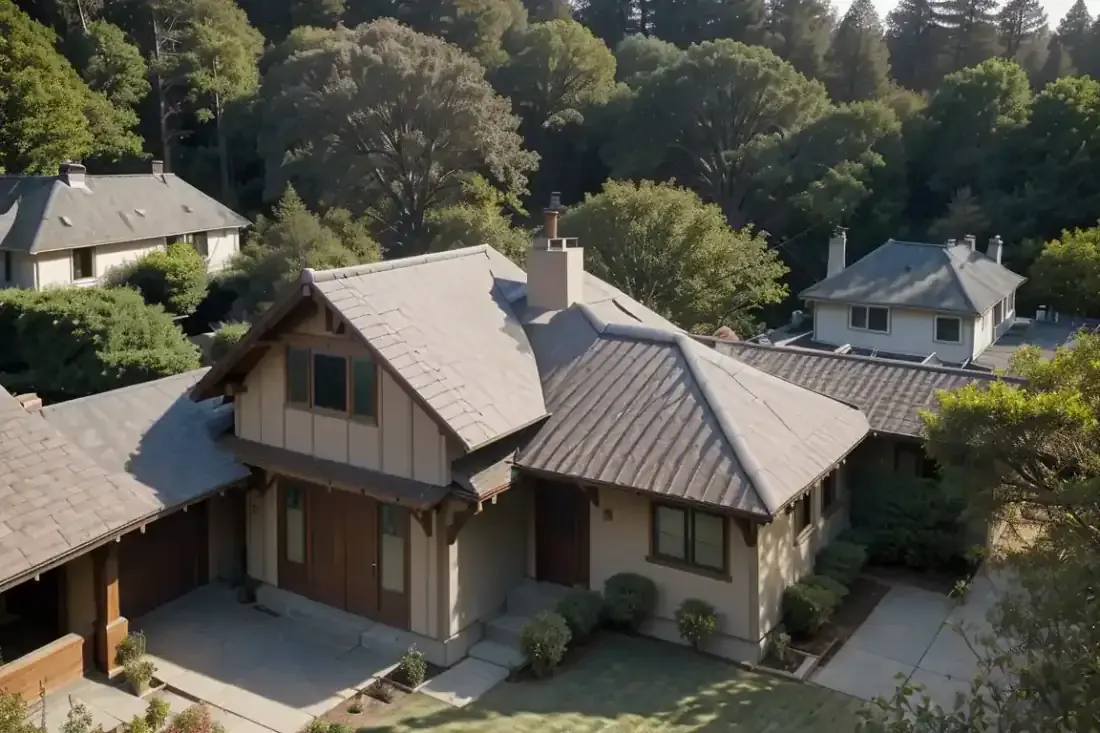
Roofing in Oakland, CA
Oakland's roofing work starts with the ground it sits on.
West Oakland holds surviving Italianate Victorian houses at Oakland Point, some dating from the boom that began about 1875.
Call (415) 753-4712Serving Oakland and
Post-1906 expansion then filled North Oakland and parts of East and West Oakland with Colonial Revival and shingled or stuccoed Arts and Crafts houses.
East Oakland, Chinatown, and Piedmont Pines each carry their own mix of composition asphalt shingles, tile roofing, and flat or low-slope TPO and modified bitumen systems.
The hills are the other half of the story.
Wildfire ember exposure in the WUI is real, and the city names vents, roofline gaps, and debris-filled gutters as ignition pathways.
Class A roofs are required for new WUI construction, with a separate bulletin covering alterations and repairs. - Ember entry at eave and ridge vents
- Gutter debris that holds embers against the fascia
- Open gaps at the roof deck edge and soffit
Winter brings storm runoff and hillside drainage.
City landslide guidance calls for checking roofs, gutters, and chimneys and routing discharge to adequate drainage rather than unstable slopes.
That means downspout placement matters as much as the shingle itself. Typical failure modes follow the calendar.
Winter wind-driven rain finds failed flashing, worn pipe boots, and old roof cement patches. Flat and low-slope roofs pond where scuppers and drains clog.
Summer sun then dries out old sealant and caulk, opening seams.
On older North Oakland and West Oakland homes, deferred maintenance shows up as rot at the fascia and soffit long before the field shingles fail.
What Roofing Work in Oakland Includes
A roof inspection begins with the deck, not the shingles.
A roofer checks the sheathing for soft spots, the rafters and joists for sag or rot, and the ridge beam where the roof ties together.
On older houses, a hip or gable roof may hide a failing purlin or a cracked rafter tail.
- Deck and structure: sheathing, plywood or OSB panels, rafters, joists, ridge beam
- Waterproofing layers: roofing felt or synthetic underlayment, ice-and-water shield at valleys and eaves
- Edge metal: drip edge, apron flashing, step flashing, counter-flashing, chimney flashing
- Penetrations: pipe flashing, boot flashing, skylight curbs, vent boots
- Above-roof: ridge cap, ridge vent, soffit vent, attic fan, ventilation balance
Tear-off is physical work.
Crews use a roofing shovel and pry bar to strip old shingles, then a nail gun and air compressor for the new field.
On flat sections, a torch or mastic and roof cement handle modified bitumen and membrane laps. Every roofing square gets counted against the bid.
Materials get matched to the roof shape. Architectural shingles suit gable and hip planes.
Three-tab shingle, wood shake, cedar shake, slate, clay tile, and concrete tile each demand different fastening and substrate.
Standing-seam panel and corrugated panel need clip systems and careful fastener placement.
Above-roof details that matter:
- Valley and flashing work, including step flashing and counter-flashing
- Skylight and dormer integration
- Parapet, coping, and scupper detailing on flat roofs
- Ridge vent and soffit vent balance for attic ventilation
Cleanup is part of the scope.
A dumpster and debris removal, a magnet sweep for nails and screws, and a final walk of the gutter and downspout line.
Scaffold and ladder staging must be planned before work starts, not improvised.
Questions about your roof?
Call (415) 753-4712Quality & Materials Standards
Honest roofing standards start with what the building code requires and what the parcel actually carries.
Class A ratings apply to new WUI construction, but the replacement trigger for existing roofs needs parcel confirmation.
In climate zone 3, 2025 single-family reroof provisions do not impose prescriptive cool-roof reflectance requirements.
That is not an exemption for multifamily or commercial buildings, so confirm scope before signing.
- Verify the roofing contractor's license and insurance
- Confirm the re-roofing certificate: one per structure, self-certified completion, 180-day validity
- Ask which substrate and underlayment the bid specifies
Materials choices carry real trade-offs. Synthetic underlayment outlasts older tar paper in most cases.
Ice-and-water shield belongs at valleys and eaves where ice dam risk or wind-driven rain concentrates. Ice dam risk is modest here, but valleys still take water.
Fastening discipline separates a good roof from a callback. Nail placement, screw type for metal panel, and fastener spacing on standing-seam panel all follow the manufacturer.
A vapor barrier belongs where the assembly calls for it, not by default.
- Sealant and caulk are maintenance, not structure
- Roof cement and mastic are temporary fixes
- Coating extends a membrane life but hides nothing
Details that fail first: boot flashing, pipe flashing, and chimney flashing. Counter-flashing at a parapet or chimney wall needs proper embedment.
A snow guard is rarely needed here but is sometimes specified on steep slate or tile.
Roof shapes vary. A mansard, gambrel, or steep gable changes eave and overhang detail. A canopy or awning attachment point is a common leak source.
Verge and rake edges need drip edge and proper overlap.
Insurance vocabulary matters. Document the failure mode with photos before any repair. Distinguish storm damage from wear and deferred maintenance.
Get a written roof estimate with line items: tear-off, decking replacement, substrate, flashing, and cleanup. Ask what the certificate covers and who files it.
Seasonal and Storm Exposure in Oakland
Oakland’s roof calendar splits into two hazards that peak at opposite times of year.
Winter rains arrive from the Pacific and run off hillside streets fast, so rooftop drainage matters as much as the shingles.
City landslide guidance asks homeowners to check roofs, gutters and chimneys and to route discharge to adequate drainage rather than unstable slopes.
That makes late-fall the right window for a roof inspection, before the first sustained storms.
In the hills and the wildland-urban interface, the dry months bring the other risk.
Ember exposure is the named pathway, and the city lists vents, roofline gaps and debris-filled gutters as the points where embers enter.
A rooftop loaded with pine needles and dry debris is a fuel bed. Clearing it is a pre-summer task, not a fall one.
Materials age differently under this pattern. Asphalt shingle and three-tab shingle lose granules, then crack at the valley and ridge cap.
Older wood shake and cedar shake dry and split, and debris lodges between them.
Clay tile and concrete tile shed water well but crack after freeze-thaw and tree impact, letting underlayment take the load.
Flat and low-slope systems — modified bitumen, TPO, built-up roof — fail first at seams and parapet edges. Ponding after a storm finds every weak lap.
A membrane that looked fine in August can show blisters by January.
Timing follows from all this:
- Late fall: roof inspection, gutter and downspout clearing, flashing checks before rain.
- Early spring: post-storm review of valleys, eave lines and pipe flashing.
- Late spring: WUI clearance, vent screening, debris removal from the roof deck.
For the 2025 single-family reroof rules, CEC ZIP data places Oakland in climate zone 3, where prescriptive cool-roof reflectance requirements do not apply.
That is a single-family finding only; multifamily and commercial questions need parcel confirmation.
Questions about your roof?
Call (415) 753-4712Local Service Areas
West Oakland
West Oakland holds some of the city’s oldest surviving housing, including Italianate Victorian houses at Oakland Point from the building boom that began about 1875.
Those steep roofs reward careful flashing work and honest material assessment.
- Original wood shake and cedar shake on Victorian rooftops, often split and brittle after a century of dry summers.
- Dormer and mansard transitions where step flashing and counter-flashing have rusted through.
- Ornate overhang and canopy details that trap debris and hide soft fascia boards.
- Flat rear additions using modified bitumen or a built-up roof, where seams blister at the parapet.
- Older roof deck boards under slate or replacement shingle, sometimes too far gone for a simple overlay.
North Oakland
Post-1906 expansion filled much of North Oakland with Colonial Revival and Arts and Crafts houses, many shingled or stuccoed.
The era’s framing and rooflines are consistent, which helps when planning a replacement.
- Shingled and stuccoed Arts and Crafts gables where the verge trim and rake boards rot quietly.
- Hip and gable roofs with original 1x sheathing that should be checked before any new underlayment goes down.
- Clay tile or concrete tile on period homes, where cracked pieces let water past the felt.
- Attic spaces needing soffit vent and ridge vent balance to stop winter condensation.
- Chimney flashing and masonry joints that open up after wet winters.
East Oakland
East Oakland’s housing spread across many decades, so a single block can mix bungalows, stucco flats and later additions.
Roof age varies as much as the architecture.
- Composition asphalt shingle roofs at or past service life, curling at the rake and losing granules.
- Low-slope garage and addition roofs in tar and modified bitumen, ponding at the scupper.
- Pipe boot and vent boot failures around plumbing stacks, a common leak source in wet winters.
- Aluminum gutter runs with sagging hangers and downspouts discharging too close to the foundation.
- Skylight and dormer penetrations where old sealant and caulk have dried out.
Piedmont Pines
Piedmont Pines sits in the hills, where wildfire ember exposure and steep terrain shape every roofing decision.
The city’s WUI guidance and Class A requirements are most directly relevant here.
- Roofline gaps, eave openings and unscreened vents that let embers into the attic.
- Gutters packed with pine needles and leaf debris, named by the city as an ignition pathway.
- Wood shake roofs on older hillside homes that need an ember-resistance review.
- Hillside drainage: downspouts and discharge routing matter when slopes are unstable.
- Decks and overhangs near the roofline where debris accumulates out of sight.
Chinatown
Chinatown’s dense, older commercial and residential buildings lean on flat and low-slope roofing. Parapets and shared walls make waterproofing details the whole game.
- Built-up roof and modified bitumen surfaces on older buildings, with seams failing at the parapet.
- Coping and counter-flashing at shared walls where adjacent roofs meet.
- Scuppers and internal drains that clog and back up water during storm runoff.
- Mansard and gambrel rear sections on mixed-use buildings, often patched repeatedly.
- Rooftop equipment penetrations needing fresh boot flashing and sealant.
Get Your Oakland Roof Reviewed
Oakland roofs face ember exposure in the hills and storm runoff everywhere else, and the fix starts with knowing what is actually up there.
Ask any roofing contractor for a written roof estimate, a look at the roof deck and attic, and a clear statement on building code and WUI requirements for the parcel.
Then verify permits through the city’s online Re-Roofing Certificate process. Call (415) 753-4712 or use the contact form to start a roof inspection.
Questions about your roof?
Call (415) 753-4712Services in Oakland
Roof Repair
Professional roof repair services in Oakland.
Roof Inspection
Professional roof inspection services in Oakland.
Roof Replacement
Professional roof replacement services in Oakland.
Gutter Installation
Professional gutter installation services in Oakland.
Metal Roofing
Professional metal roofing services in Oakland.
Roof Leak Detection
Professional roof leak detection services in Oakland.
Storm Damage Repair
Professional storm damage repair services in Oakland.
Commercial Roofing
Professional commercial roofing services in Oakland.
Insurance Claim Assistance
Professional insurance claim assistance services in Oakland.
Tile Roofing
Professional tile roofing services in Oakland.
Fascia Soffit Repair
Professional fascia soffit repair services in Oakland.
Roof Ventilation
Professional roof ventilation services in Oakland.
Shingle Roofing
Professional shingle roofing services in Oakland.
Emergency Roof Repair
Professional emergency roof repair services in Oakland.
Skylight Installation
Professional skylight installation services in Oakland.
Roof Coating
Professional roof coating services in Oakland.
Compare Written Estimates in Oakland
Independent Local Providers and provider-held · serving California
Call (415) 753-4712