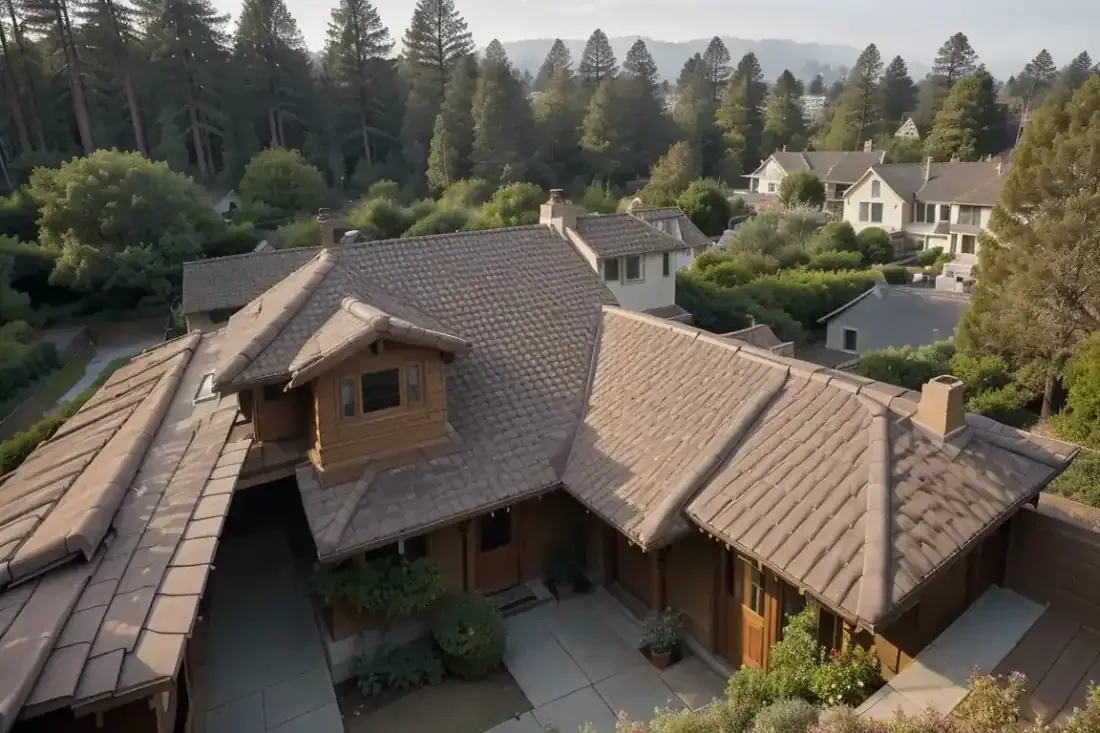
Roofing in Richmond, CA
Richmond's roofing challenges start with geography. This Contra Costa city sits at roughly 10 feet elevation, where bay air meets hillside blocks.
Call (415) 753-4712Serving Richmond and
Fog rolls through the Marina Bay and Coronado waterfront most summer mornings. Salt air corrosion is a year-round issue for any rooftop near the shoreline.
Housing stock here spans three distinct eras. Point Richmond holds early-1900s craftsman and Victorian homes with steep, complex rooflines.
Mid-century worker housing from the 1940s and 1950s fills the Panhandle and Iron Triangle. Modern waterfront developments line Marina Bay with low-slope and flat assemblies.
Each era fails differently. Older Point Richmond roofs often show dry-rotted sheathing under worn shingle.
Mid-century homes tend to have tired three-tab shingle and failing pipe flashing. Waterfront flat roofs develop membrane seams pulled apart by wind uplift.
Winter storms bring strong bay winds and driven rain that finds every weak flashing detail.
The Chevron Richmond Refinery adds a factor most homeowners do not consider. Airborne particulates settle on roofs and accelerate coating breakdown.
Specialized roof coating systems often make more sense here than in cleaner airsheds. A roofer working in Richmond should know the difference.
- Salt corrosion attacks fasteners, drip edge, and metal panel near the Bay Trail. - Marine-layer moisture feeds moss and algae on north-facing slopes.
- Wind-driven rain pushes past step flashing and chimney flashing during winter storms. - Refinery fallout degrades elastomeric coatings faster than normal.
Typical failure modes in Richmond follow that pattern. Corroded fasteners loosen ridge cap and rake trim.
Failed sealant at pipe boots lets water track down into ceiling joists.
On older Victorians, neglected gutter and downspout systems back up and rot the fascia and soffit.
What Roofing Work in Richmond Includes
A proper roof inspection starts at the deck and works outward.
The roofer checks attic-side sheathing for staining, then walks the field to map lifted shingle, cracked tile, and exposed nail heads.
Expect photos of every deficiency, not just a verbal summary.
Tear-off and preparation come next. Crews strip the old roofing down to plywood or OSB sheathing and inspect the roof deck for soft spots.
Rotted decking gets replaced before anything new goes down. A dumpster sits on-site for debris, and magnets sweep the yard for stray nails.
Materials depend on the assembly and the home:
- Steep-slope homes: architectural shingle over synthetic underlayment, with ice-and-water shield in valleys and at eaves.
- Historic Point Richmond: wood shake or cedar shake where the original look matters, sometimes clay tile or slate on period homes.
- Flat and low-slope sections: TPO, EPDM, or PVC membrane, or a built-up roof with modified bitumen.
- Metal options: standing-seam panel for longevity, corrugated panel for outbuildings and awnings.
The sequence is disciplined. Underlayment goes down first, then drip edge along every eave, then field material from the eave up.
Valley and step flashing get woven or set before the field covers them.
Ridge cap and ridge vent finish the top, and vent boots seal each penetration.
Ventilation matters as much as the surface. Soffit vent intake and ridge vent exhaust keep the attic dry and cut ice dam risk on cold snaps.
A roofer should confirm the balance before closing up the roof.
Cleanup closes the job. Debris haul-off, gutter clearing, and a final walk with the homeowner belong in the scope.
So does a written roof estimate that itemizes tear-off, materials, and labor.
Questions about your roof?
Call (415) 753-4712Quality & Materials Standards
Material standards in Richmond start with corrosion resistance. Standard galvanized fasteners and flashing pit fast near the waterfront.
Specify stainless or hot-dip galvanized hardware, and check that drip edge and valley metal carry the same rating.
Building code sets the floor, not the ceiling. California code requires ice-and-water shield at eaves and valleys on steep-slope roofs.
Underlayment must meet the manufacturer's spec for the pitch. A roofing contractor who skips these steps is cutting corners the inspector may not catch.
Assembly quality lives in the details:
- Correct nail placement and depth in each shingle, driven by nail gun at the right pressure.
- Step flashing and counter-flashing at chimneys and sidewalls, not just caulk.
- Proper pipe boot or vent boot replacement on every penetration.
- Sealant used as a supplement, never as the primary waterproofing.
- Fastener spacing that matches the manufacturer's published schedule.
Insurance claims deserve honesty. Storm damage from bay winds is real, but not every worn roof qualifies.
A roofer should document damage with photos and let the adjuster decide. Homeowners should verify the contractor's license and insurance before work begins.
Coating and coating systems need scrutiny too. Elastomeric coatings can extend a flat roof's life, but only over sound substrate.
Coating a wet or blistered membrane traps moisture and makes things worse. Ask what surface preparation precedes any coating application.
Finally, ask about the roof estimate in writing. A real scope names materials, quantities in roofing squares, and the ventilation plan.
Anything vaguer is a red flag worth walking away from.
Seasonal and Storm Exposure in Richmond
Summer fog rolls in off the bay and parks over the flats for days. That marine layer keeps shingles cool but never lets them dry.
Moisture sits on the roof deck and works under laps.
Salt air from the waterfront accelerates corrosion on every fastener and metal edge. Galvanized nails and drip edge degrade faster here than inland.
A roof that looks fine from the street can hide rusted fasteners underneath.
Winter brings strong Bay winds driving rain sideways into the roofline. Wind lifts three-tab shingle tabs and forces water past flashing at walls and chimneys.
Storms strip granules into gutters and downspouts until drainage backs up.
Inspect in spring after the last rain and again in fall before the first. Spring catches winter damage while it is fresh.
Fall inspection finds lifted shingles and loose flashing before the rains return.
Air quality near the industrial corridor adds another layer. Exhaust and particulates settle on the rooftop and break down coatings.
Older asphalt shingle surfaces chalk and thin faster on the north and east exposures.
Watch for these signs after a storm:
- Granules collecting at downspout outlets
- Curling or lifted shingle tabs on windward slopes
- Rust streaks on flashing and pipe boots
- Sagging along the eave or ridge line
- Water stains on soffit or fascia boards
Timing matters more than most homeowners realize. A roof inspection scheduled before the rainy season catches small failures cheaply.
Waiting until a ceiling stain appears usually means decking damage already started.
Questions about your roof?
Call (415) 753-4712Local Service Areas
Iron Triangle
The Iron Triangle holds dense blocks of early 1900s worker housing packed close together.
Roofs here are often original or one layer over old decking, and access is tight.
- Flat and low-slope roofs over additions often rely on a built-up roof or modified bitumen that cracks at seams.
- Old tar and gravel surfaces pond water where the pitch has settled, and ponding finds every seam.
- Shared walls and narrow lots mean step flashing and counter-flashing at party walls fail first.
- Corrugated panel and metal panel roofs on rear sheds rust through at fasteners.
- Gutter runs are short and clog fast, sending water against the fascia.
Marina Bay
Marina Bay's modern waterfront developments sit closest to the salt air, and the buildings are newer but not immune.
Wind-driven rain off the open water hits exposed elevations hardest.
- Standing-seam panel and metal panel roofs show corrosion at fasteners and panel laps near the water.
- TPO and PVC membrane roofs on low-slope sections need seam checks after every wind event.
- Rooftop decks and parapet walls collect water where scupper drains clog with debris.
- Balcony overhangs and canopy structures trap moisture at the attachment points.
- Sealant and caulk joints at penetrations dry and crack within a few seasons.
Panhandle
Panhandle's mid-century worker housing from the 1940s and 1950s has reached the age where second roofs are common.
Low hip and gable rooflines make for straightforward but repetitive work.
- Three-tab shingle roofs from later re-roofs are now curling and losing granules.
- Original sheathing is often spaced board decking that flexes under new loads.
- Ridge vent and soffit vent combinations are frequently undersized for the attic volume.
- Pipe flashing and vent boots on the many penetrations crack at the rubber collar.
- Fascia boards behind old gutters show rot where downspouts have discharged against the wall.
Coronado
Coronado blends small stucco homes with a few larger remodels, and roof styles vary block to block. Mixed roofing types on one structure create transition problems.
- Where a tile section meets an asphalt shingle section, the valley and step flashing are the weak point.
- Clay tile and concrete tile underlayment ages out long before the tile itself.
- Dormer and skylight penetrations rely on old tar and roof cement that hardens and splits.
- Wood shake and cedar shake on older cottages dry, cup, and split along the grain.
- Attic insulation sits compressed, and ventilation through soffit vent slots is blocked by paint.
North Richmond
North Richmond's housing runs older and more varied, with industrial exposure close by. Roofs take both marine moisture and airborne fallout from the corridor.
- Coatings on flat roofs chalk and fail faster where airborne particulates settle.
- Asphalt and bitumen surfaces oxidize, and the surface turns brittle before leaks appear.
- EPDM membrane on older flat sections shrinks and pulls at perimeter terminations.
- Chimney flashing and apron flashing on masonry chimneys show cracked mastic.
- Ladder access is often limited, so roof inspection and debris removal need planning.
Bayview
Bayview sits exposed to bay wind and salt, and its roofs show the wear. Windward slopes take the worst of it.
- Wind-driven rain pushes under rake and verge edges where shingles lift.
- Ice-and-water shield at the eave helps, but older roofs skip it and pay at the overhang.
- Architectural shingle fields hold up better than three-tab, yet both lose sealant strips in high wind.
- Downspouts discharging at grade erode soil and rot the lower fascia.
- Metal chimney caps and vent boots rust through at the screw heads.
Get a Richmond Roof Assessment
Richmond roofs face fog, salt, wind, and industrial fallout in a single year. A proper roof inspection maps what is actually failing and what can wait.
Ask any roofing contractor for a written roof estimate that names materials, flashing details, and ventilation fixes.
Verify licensing and insurance before work begins, and get the scope in writing.
Call (415) 753-4712 or use the contact form to start a conversation about your rooftop.
Questions about your roof?
Call (415) 753-4712Services in Richmond
Roof Repair
Professional roof repair services in Richmond.
Roof Inspection
Professional roof inspection services in Richmond.
Roof Replacement
Professional roof replacement services in Richmond.
Gutter Installation
Professional gutter installation services in Richmond.
Metal Roofing
Professional metal roofing services in Richmond.
Roof Leak Detection
Professional roof leak detection services in Richmond.
Storm Damage Repair
Professional storm damage repair services in Richmond.
Commercial Roofing
Professional commercial roofing services in Richmond.
Insurance Claim Assistance
Professional insurance claim assistance services in Richmond.
Tile Roofing
Professional tile roofing services in Richmond.
Fascia Soffit Repair
Professional fascia soffit repair services in Richmond.
Roof Ventilation
Professional roof ventilation services in Richmond.
Shingle Roofing
Professional shingle roofing services in Richmond.
Emergency Roof Repair
Professional emergency roof repair services in Richmond.
Skylight Installation
Professional skylight installation services in Richmond.
Roof Coating
Professional roof coating services in Richmond.
Compare Written Estimates in Richmond
Independent Local Providers and provider-held · serving California
Call (415) 753-4712