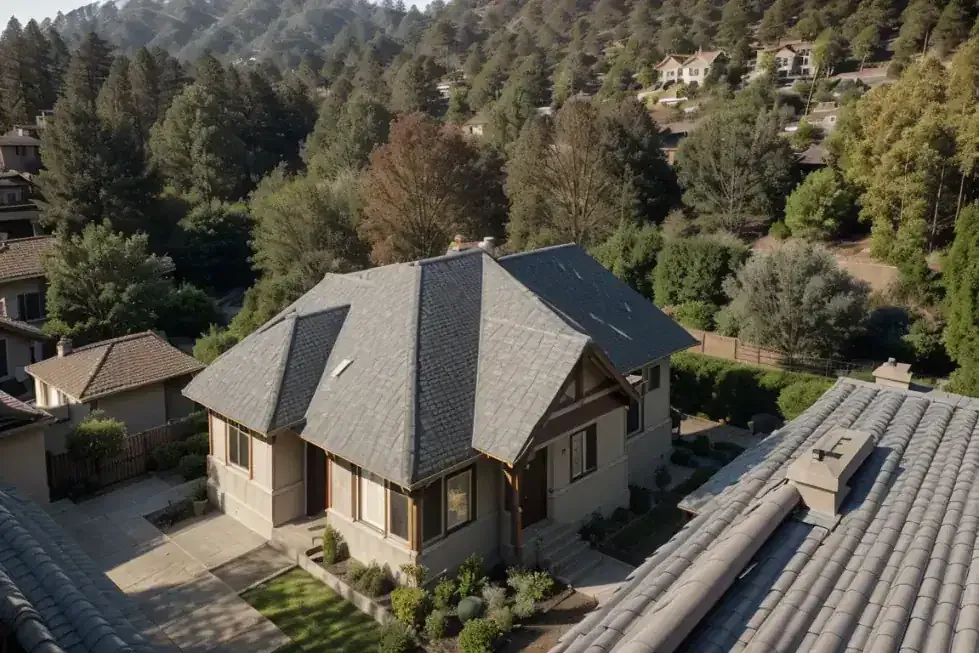
Roofing in Union City, CA
Union City roofing has to answer two different threats on the same property.
West of Mission Boulevard, the concern is rain — the Building Division designs for 1.
Call (415) 753-4712Serving Union City and
5 inches per hour, so gutters, downspouts and flashing carry real volume. East of Mission, the city draws its Wildland Urban Interface Zone line.
Roofs there sit in wildfire exposure as well as storm exposure. The housing stock splits by district too.
Alvarado mixes 1970s ranch housing with multistory homes built since the 1990s.
Spanish and Mission style elements show up along the Mission Boulevard corridor, red clay tile included.
Decoto, the Station District and Station East add their own rooflines. What fails first here is rarely dramatic.
It is water finding a path it should not:
- Failed pipe boots and step flashing at wall intersections
- Clogged valley gutters backing up under shingles
- Aged sealant at counter-flashing on chimneys
- Wind-lifted ridge cap and damaged rake edges
- Ponding on flat membrane sections over additions
Red tile needs its own discipline. Cracked clay tile admits water, and walking a tile roof carelessly breaks more of it.
Older ranch roofs often hide worn roofing felt under three-tab shingle courses.
What Roofing Work in Union City Includes
Any roof estimate starts with a roof inspection, not a sales pitch.
A roofer should walk the rooftop, check the attic underside for staining, and photograph the findings.
Scope of a typical reroof or repair:
- Tear-off of existing shingle, tile or membrane down to roof deck
- Decking inspection — plywood or OSB, with soft spots replaced
- Underlayment, often synthetic underlayment, plus ice-and-water shield at valleys and eaves
- New drip edge, valley flashing and pipe flashing
- Field material, ridge vent and ridge cap at the ridge line
- Final cleanup and debris haul-off in a dumpster
Materials vary by roof section. Pitched roofs take asphalt shingle — architectural or three-tab — or clay tile and concrete tile.
Flat sections take TPO, EPDM or a modified bitumen membrane. Historic and Craftsman homes may keep wood shake or cedar shake where code allows.
Process details a homeowner should see confirmed:
- Whether a roofing permit is filed with the City of Union City Building Division
- Whether the reroof adds weight to the structure
- How the crew protects landscaping and gutters during tear-off
- Where scaffold or ladder access lands on the property
Cleanup includes magnet sweeps for nails and fasteners. A good crew also checks that downspouts drain away from the foundation after the job.
Questions about your roof?
Call (415) 753-4712Quality & Materials Standards
Building code sets the floor, not the ceiling. Union City sits in climate zone 3, so a single-family reroof carries no prescriptive cool roof reflectance requirement.
That makes material choice a judgment call, not a checkbox.
Underlayment quality matters more than most homeowners expect.
Synthetic underlayment outlasts organic roofing felt, and ice-and-water shield belongs at every valley and eave, even where ice dam risk is low.
Step flashing and counter-flashing should be metal, not mastic and caulk smeared over a gap.
On tile roofs, the substrate and battens carry the load. A rotten purlin or rafter shows up as a sagging roofline.
Flat sections need correct pitch to a scupper or drain, plus a vapor barrier where insulation sits below the deck.
Fire exposure east of Mission Boulevard deserves a direct question at the estimate. Ask what the parcel-level WUI requirement actually is for that address.
Insurance claims follow documentation, not opinion. Useful records include:
- Date of loss, for storm or fire damage
- Photos of damage before repair
- A written scope separating storm damage from wear
- Roofer's note on whether repair or replacement is justified
Honest roofers distinguish maintenance from damage. A worn pipe boot is maintenance; hail-bruised shingle fields may be a claim.
Get the distinction in writing before signing anything.
Seasonal and Storm Exposure in Union City
Union City's wet season runs roughly November through March, and the rain arrives in concentrated bursts.
The Building Division's 1.5 inch per hour rainfall design criterion tells you what the roof must handle.
Gutters, downspouts and flashing carry that volume or the water finds a path inside.
East of Mission Boulevard, the Wildland Urban Interface Zone changes the seasonal math. Summer and fall bring dry fuels and ember exposure.
A roof's weatherproofing and the debris held in a valley or gutter both matter then. Wind-driven embers seek the same gaps that winter rain exploits.
Here is how the common materials respond:
- Asphalt shingle roofs lose granules along south-facing slopes; three-tab shingle fields show it first.
- Clay tile and concrete tile resist sun but crack at step flashing and valley cuts where movement concentrates.
- TPO and EPDM membrane on flat sections pond water when a scupper or drain clogs with debris.
- Wood shake and cedar shake dry, split, and hold moisture in the laps after a wet spring.
Timing follows the pattern. A roof inspection in late fall catches loose fasteners and failed sealant before the first real storm.
A second look after the rainy season finds what the winter stressed. Those are the two windows worth scheduling.
Look for the quiet failures between visits. Curling shingle tabs, grit in the gutters, rusted pipe boot collars, and stains on a soffit.
Each points to a specific repair, not a whole roof.
Wildfire exposure adds one more check.
Confirm with the Building Division what parcel-level requirements apply before any reroof, since the WUI line east of Mission Boulevard governs more than material choice.
Climate zone 3 means no prescriptive cool roof reflectance rule for single-family reroofs, so selection stays a design decision.
Get a written roof estimate that names the underlayment and flashing plan.
Questions about your roof?
Call (415) 753-4712Local Service Areas
Historic Alvarado District
Alvarado holds 1970s ranch housing beside multistory homes built since the 1990s, so roof ages and systems vary block by block.
The older ranches and newer builds fail differently, and each needs its own inspection lens.
- Original ranch roofs often carry aging three-tab shingle over old roofing felt, and the tar paper beneath may be brittle when a roofer pulls a test square.
- Low-slope additions on these ranches commonly use modified bitumen or a built-up roof, where ponding shows as blistered seams and split tar.
- Multistory homes from the 1990s onward tend toward architectural shingle with synthetic underlayment; watch for lifted ridge cap and loose nail heads at the rake.
- Queen Anne, Craftsman and Contemporary architecture here means complex rooflines, with dormer and gable intersections that demand careful step flashing.
- Old galvanized gutters on the ranch homes rust at the seams, sending runoff down the fascia instead of the downspout.
Decoto
Decoto's tighter lots and older housing stock put roof edges close to neighboring structures.
That proximity makes overhang and drainage details matter as much as the field shingle.
- Compact setbacks mean a ladder often cannot reach the eave safely, so a proper roof inspection may call for scaffold rather than a leaning ladder.
- Many homes show layered shingle from past reroofs; a roofer must confirm the substrate and decking can take another layer before quoting.
- Porch and entry canopy roofs, some with awning-style covers, trap debris against the wall and rot the fascia behind them.
- Pipe flashing and vent boot collars age out on these roofs first; cracked rubber shows as a ceiling stain after a hard rain.
- Check the valley where two roof planes meet, since leaf buildup there backs water under the shingle laps.
Station District
Station District mixes commercial buildings with residential additions, so flat membrane systems sit beside pitched roofs. Each type fails on its own schedule.
- Commercial flat roofs here use TPO, EPDM or PVC membrane; seam separation and punctures are the usual culprits.
- A parapet wall detail is a frequent leak source, where counter-flashing meets the wall and coping.
- Residential additions with low-slope sections often hide a membrane under a shallow pitch, and ponding reveals it.
- Scuppers and internal drains clog with debris and need clearing before the rainy season, not after.
- Older commercial roofs may carry a built-up roof with gravel surfacing, where the bitumen dries and cracks.
Station East
Station East leans toward newer multistory construction, and the rooflines reflect it. Modern systems dominate, but installation details decide whether they last.
- Architectural shingle on steep pitches is common, and ridge vent and soffit vent balance governs attic ventilation.
- Hip and gable combinations create multiple valleys, each a candidate for ice-and-water shield placement errors.
- Dormer and skylight penetrations need fresh flashing and sealant checked yearly, since caulk shrinks.
- Some roofs carry a mansard or gambrel profile on accent sections, where the steep verge and rake take wind load.
- Truss and rafter connections inside the attic are worth a look if a roofer reports sagging at the ridge beam.
Get a Roof Estimate You Can Verify
Before hiring anyone in 94587, ask for a written roof estimate that names the materials, the underlayment, and the flashing plan.
Confirm the roofing contractor pulls a permit through the City of Union City Building Division, since simple reroofs without added weight can go over the counter.
Ask what a roof inspection covers and whether debris removal is included.
Call (415) 753-4712 or use contact form to start the conversation with a local roofer who knows this climate.
Questions about your roof?
Call (415) 753-4712Services in Union City
Roof Repair
Professional roof repair services in Union City.
Roof Inspection
Professional roof inspection services in Union City.
Roof Replacement
Professional roof replacement services in Union City.
Gutter Installation
Professional gutter installation services in Union City.
Metal Roofing
Professional metal roofing services in Union City.
Roof Leak Detection
Professional roof leak detection services in Union City.
Storm Damage Repair
Professional storm damage repair services in Union City.
Commercial Roofing
Professional commercial roofing services in Union City.
Insurance Claim Assistance
Professional insurance claim assistance services in Union City.
Tile Roofing
Professional tile roofing services in Union City.
Fascia Soffit Repair
Professional fascia soffit repair services in Union City.
Roof Ventilation
Professional roof ventilation services in Union City.
Shingle Roofing
Professional shingle roofing services in Union City.
Emergency Roof Repair
Professional emergency roof repair services in Union City.
Skylight Installation
Professional skylight installation services in Union City.
Roof Coating
Professional roof coating services in Union City.
Compare Written Estimates in Union City
Independent Local Providers and provider-held · serving California
Call (415) 753-4712